


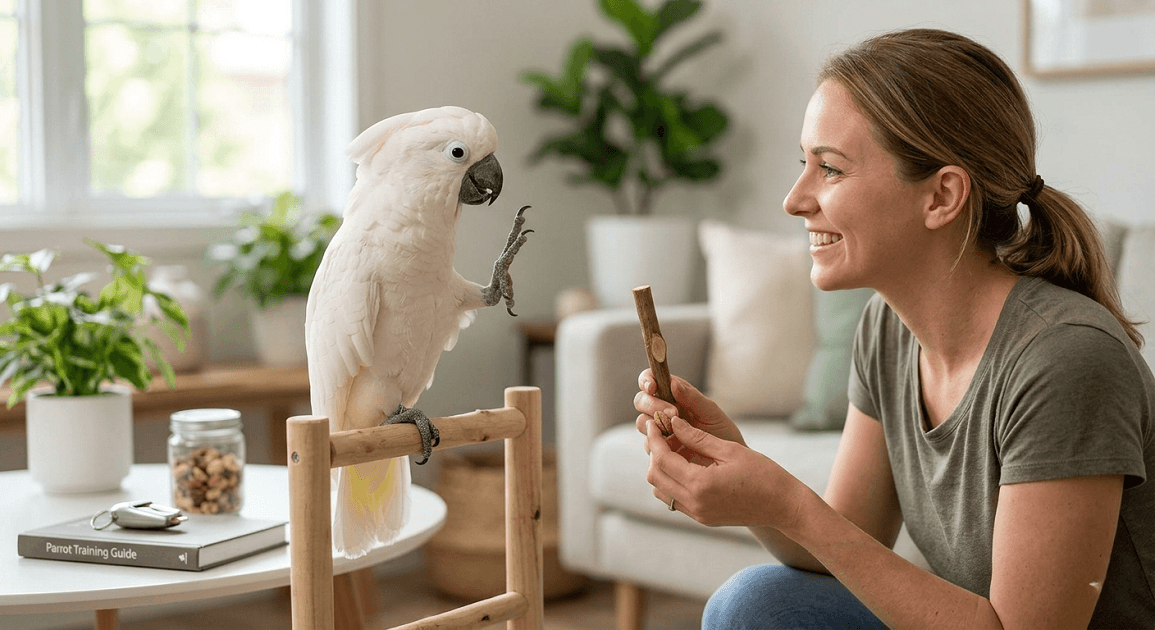
All parrot lovers dream of feathered friends who can talk, perform tricks, and interact playfully. However, birds don’t learn these behaviours automatically. To learn your bird tricks, you need to train it properly. Cockatoos are among the most intelligent and emotionally expressive parrots you can own. Their playful personality, affectionate nature, and strong bonding instincts make them incredible companions. However, determining whether a cockatoo is the right pet for you depends entirely on your willingness to invest time in their care and training.
Whether you are bringing home a new Umbrella Cockatoo, a Moluccan, or a Goffin’s or Galah Cockatoo, this guide provides essential steps for building a strong bond, establishing good behavior control to advanced skills like talking, tricks, and even free flight. Everything here is designed for practical, real-world results.
If you are still exploring your options or looking to add a new feathered member to your family? Check our up-to-date Cockatoo Pricing and find the perfect companion for your home.
- Successful Cockatoo training needs consistency, patience, and building a strong bond with your bird.
- Behavioral issues such as biting and screaming are not random. These are forms of communication.
- Start with simple words and clear cues during training. Most importantly, stay consistent and don’t give up. The results come with time and daily effort.
- Avoid punishment methods. Remember that Cockatoos respond far better to rewards than fear.
Building Trust: The Foundation of Training
Trust is essential for training. Without trust, even the best training will come to naught. If a cockatoo doesn’t feel safe with you, the bird won’t listen or cooperate with you.
At first, you need to spend quiet time near the cage. Then speak softly and consistently. To encourage their behavior, offer treats by hand and avoid sudden movements.
Let your bird approach you first. This simple step dramatically improves training speed.
Cockatoo Parrot Talking: Can They Really Learn?
While cockatoos are not quite as prolific mimics as African Greys or Amazon parrots, they can still learn surprisingly well. Though talking ability varies by individual, many Cockatoos can mimic words, phrases, and even emotional tones.
How to Teach Your Cockatoo to Talk?
Our experts say, “Before starting to learn simple words like “hi” and “hello”, start to encourage specific behaviors that a parrot performs naturally on its own.
When your parrot spontaneously says a word or performs a desired sound while they are just going about their day, you immediately offer them a treat to reinforce that action.
The timing of your reinforcement is crucial. By rewarding the behavior the moment it happens, you increase the likelihood that your bird will repeat that sound in the future.
At CA Exoticss Birds, we notice that training a bird to talk is a slow process, so this technique is a helpful tool to use alongside regular repetition and positive reinforcement.
Tips for faster results:
- Train during active hours (morning/evening)
- Use excitement in your voice
- Reward attempts immediately
Consistency matters more than session length.
Note: Be mindful of your language around your Cockatoo bird. Because, they can pick up and repeat almost any phrase, especially those spoken with strong emotions. Always speak carefully to avoid teaching words you don’t want repeated.
How to Potty Train a Cockatoo
Potty training is also all about repetition and association. While birds cannot control their bowels the same way mammals do, they can learn to eliminate waste in designated areas or on command. Learning how to potty train keeps your living space clean and strengthens the bond between you and your pet.
The Cockatoo Potty Training Process:
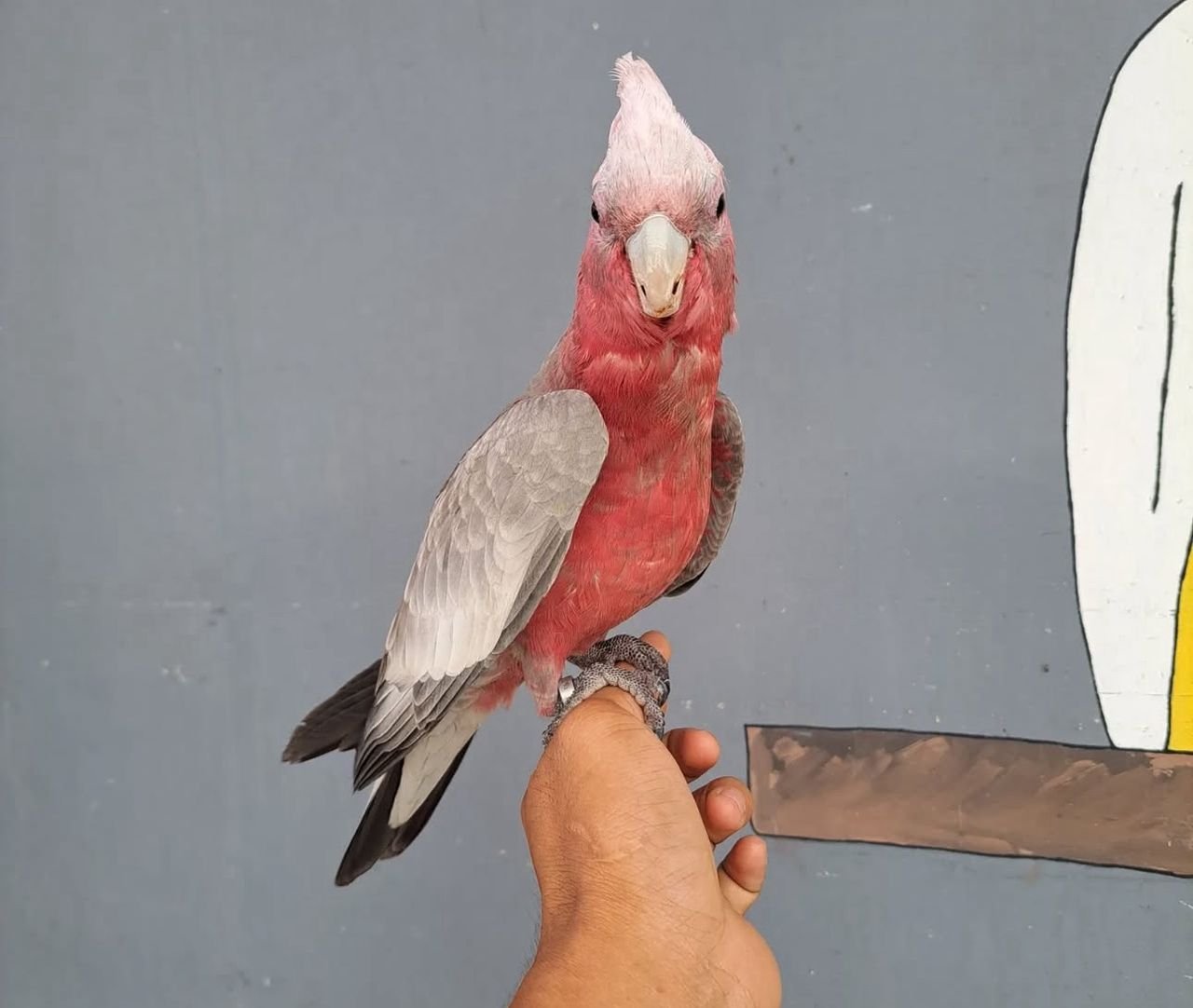
Our Process for Potty Training Leo, the Galah Cockatoo:
- Observed the pattern: At first, we spent a few hours watching Leo to determine how frequently he went to the bathroom. We noticed he pooped about every 15 to 25 minutes. He did it right after waking up or after a period of rest.
- Introduced a cue word: We started uttering consistent words like “Go potty” right before he was about to be eliminated.
- Rewarded the right location: We placed Leo on a play stand. As soon as he went, offered a high-value treat and enthusiastic praise.
- Did consistently: We took him to the target area frequently during the first few days, reinforcing the cue word consistently.
If you follow these steps, your cockatoos will be potty trained in no time. It’s as easy as that!
The potty trained parrot:
Leo
7-month-old male — Galah Cockatoo
Adoption fee:$800
Send Request
How to Train a Cockatoo Not to Bite
Cockatoos have strong, powerful beaks designed to crack nuts and strip bark in the wild. A bite can be painful and dangerous. Understanding how to train a cockatoo not to bite is one of the most important aspects of safety and trust-building.
Why Do Cockatoos Bite?
Research published on ScienceDirect shows that Cockatoos usually bite out of fear, hormonal frustration, overstimulation, or learned behavior to get their way.
Hormonal biting peaks in breeding season. Extra play and diet tweaks (less soy) can help for this.. Most cockatoos learn gentle manners in 3-6 weeks.
Bite-Proof Training:
- Learn to read body language: Before a cockatoo bites, they often give warning signs. Watch for pinned or flared crest feathers, dilated pupils, heavy panting, or an arched posture. If you see these signs, give the bird space.
- Desensitize beak: Gently touch their beak daily with a finger or stick, rewarding calm responses.
- The “Step Up” command: Establish a consistent, neutral “Step Up” command using a wooden perch or your hand (if the bird is calm). This gives the bird a defined task and takes their mind off aggressive behavior.
- Do not react with emotion: If you pull your hand away quickly, the bird may find this thrilling, reinforcing the behavior as a game. Keep your reaction calm, neutral, and gentle.
- Redirect energy: Always ensure they have plenty of chewable toys, such as wood blocks and cardboard, so they can satisfy their natural instinct to chew on safe items rather than fingers or furniture.
How to Train a Cockatoo to Stop Screaming
In the wild, cockatoos use loud calls to locate flock members over long distances. In a home, this instinct can manifest as deafening screams, especially when you leave the room or when the sun comes up.
If you want to know to stop screaming, the approach relies on rewarding silence and avoiding the reinforcement of negative attention.
Steps to Minimize Screaming:
- Never yell back: The cockatoo responds to distant shouting which it hears from another room as a signal of flocking behavior. The behavior persists because people who observe the individual react to their presence with both positive and negative attention.
- Reward quiet behavior: When your cockatoo is playing quietly with a toy or sitting calmly, walk by, offer a treat, and say “Good quiet.”
- Use the exit and enter strategy: If the bird screams for attention, you should leave the area. Keep silent and wait until the bird has stopped vocalizing for 10 seconds. The bird learns that when it stays quiet, its human will return to them.
- Provide mental stimulation: Boredom is a major cause of screaming. Rotate their toys regularly and provide foraging puzzles to keep their minds active.
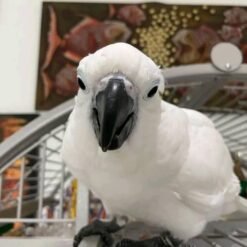
Some trained Cockatoo parrot for sale:

How Do You Free Flight Train a Cockatoo?
It is a wonderful experience when your cockatoo takes a long flight to come and land right on your hand. For advanced owners, free flight represents the ultimate level of trust and freedom.
This process requires specialized knowledge, extreme patience, and a secure environment to prevent the bird from getting lost or injured.
Free Flight Training:
- Recall training indoors: Before even considering the outdoors, practice recall in a large, safe space such as a long hallway or gymnasium. Say the bird’s name and “Come,” holding out a treat or a target stick.
- Harness training as an intermediate step: Start with a high-quality flight harness to get the bird used to the sensation of being outdoors without the risk of an unintended takeoff.
- Assess the environment: Never free-flight train in windy, rainy, or highly populated areas with predators, traffic, or loud noises.
- Build up slowly: Start with very short distances in enclosed fields, increasing distance only when your cockatoo displays 100% reliability in returning to your hand or glove.
How to Train a Cockatoo to Do Tricks and Behaviors
Teaching tricks is an excellent way to provide mental stimulation to parrots and entertainment for owners. Cockatoo birds love human interaction and challenges. With consistency, patience, and using step-by-step clicker training, owners can easily train their Cockatoos.
The Wave
Start by keeping your preferred snack outside of your bird’s reach. You should bring your hand toward its foot after you say the word “Wave.” Naturally, your cockatoo will lift its foot to steady itself or reach for the snack and that’s your golden moment!
Use your marker word (like a cheery “Good!”) the second that foot goes up and hands over the reward. With a little daily practice your Cockatoo will wave hello the moment he sees your hand move.
Spinning in Circles
Teaching the ‘Turn Around’ is like leading a tiny dance. Hold a treat near your bird’s beak and slowly guide it in a smooth circle around its head. Watch as he follows the treat with his whole body! Once he completes the full rotation, celebrate with your marker word and give your cockatoo his well-earned prize.
Diet and Its Impact on Training
Training success is directly tied to diet. A poorly fed cockatoo will lack motivation and energy. Use high-value treats during training such as Nuts (in moderation), seeds and small fruit pieces. Never overfeed during sessions. Rewards should be small but meaningful.
Summary of Training Success
Cockatoos are incredibly intelligent and emotionally complex birds. With the right approach, Cockatoo training can transform your relationship into something deeply rewarding.
Whether you’re focusing on:
- cockatoo parrot talking
- how to train a cockatoo not to bite
- how to train a cockatoo to stop screaming
- how to potty train a cockatoo
- or even how to train a cockatoo to do tricks
The key remains the same: patience, consistency, and positive reinforcement.
Keep in mind, training doesn’t happen overnight but with daily effort, your cockatoo will become a well-behaved, interactive, and joyful companion.